If you have ever sent an offer and experienced silence for several days, you know this feeling very well. The client opened the link, returned several times, spent several minutes on the offer, yet absolutely nothing happened. No email, no phone call, no "I'll get back to you next week." Just silence.
The problem in such situations is not the lack of data. On the contrary. Most offer tools today collect a lot of data, but these data say little about the actual decision-making process. You see views, time spent on the page, clicks on CTAs, but you still don't know if the client is interested, stuck on the budget, if the decision will be made tomorrow or in a month, or if it will be made at all.
At mideo, we concluded that the problem is not the amount of analytics but its quality. Therefore, instead of adding more charts and counters, we decided to rebuild offer analytics from scratch. This is how Offer Analytics v2 was born.
An Offer Is Not a Landing Page
One of the biggest mistakes in approach to offer analytics is treating an offer like a marketing page. A landing page has one goal – a quick click. A B2B offer works completely differently. It is a working document that circulates within the client’s company, reaches several people, is often read in parts, compared with other offers, and returns to play after several days or weeks.
In this context, the lack of a CTA click very often does not mean lack of interest. Sometimes it means exactly the opposite – the client is in the phase of analysis, comparisons, and internal discussions. Classic analytics cannot distinguish this. It only sees that "nothing happened."
Offer Analytics v2 assumes that an offer is a decision-making process, not a one-time interaction. Therefore, instead of looking solely at actions, we started analyzing behaviors and their context.
What Client Behavior Really Tells
Imagine two situations. In the first, the client scrolls through the offer quickly from top to bottom, spends two minutes on it, and disappears. In the second, they return three times to the budget section, linger there for several minutes, download the PDF, and after a few hours return from another device. In classic analytics, both situations may look very similar. A few views, some time spent, no clicks.
In mideo’s new analytics, these situations are completely different.
Offer Analytics v2 analyzes each section of the offer separately and assigns it a state based on the user’s real behavior. We are not only interested in whether the section was displayed. We want to know if it was read, analyzed, if the client returned to it, if they left the offer after it, and if anything happened after reading it.
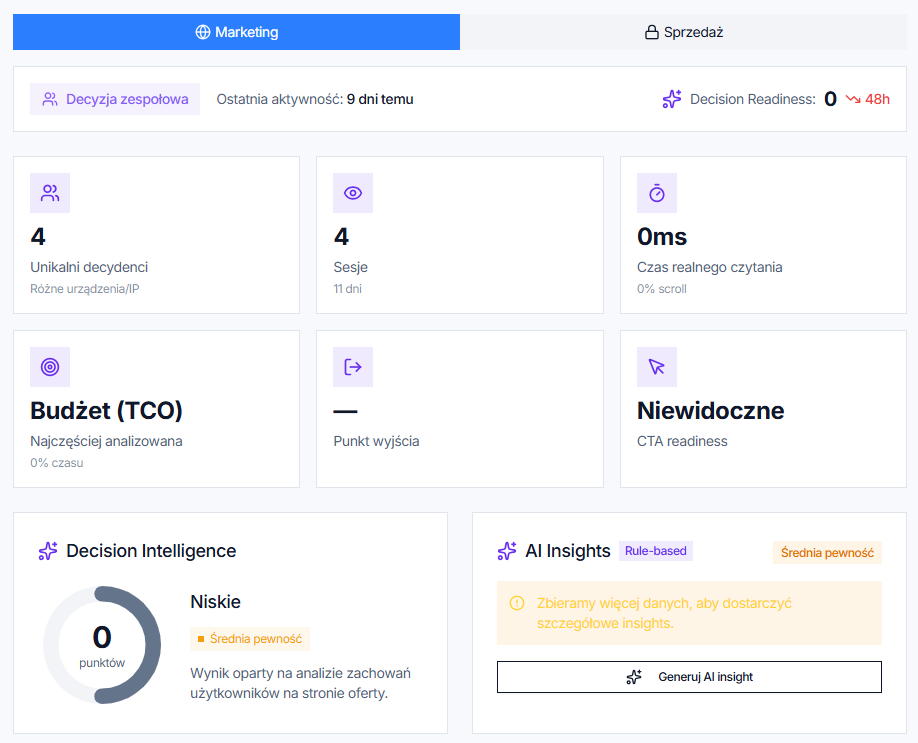
Thanks to this, instead of dry metrics, you get an interpretation. You see that the budget is being analyzed and revisited, not just "viewed." You see that the FAQ always appears after the budget, suggesting objection handling. You see that the CTA is viewed but without clicking, which very often means decision hesitation, not lack of interest.
Section Mutations Instead of Charts
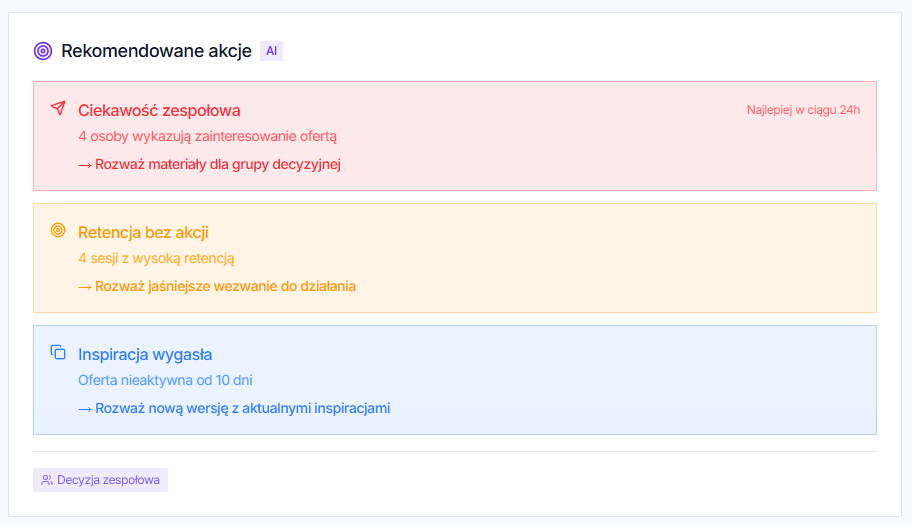
A key concept in the new analytics is section mutations. They replace dozens of indicators that previously had to be interpreted manually. A section can be skipped, scanned, read, analyzed, blocking, supporting the decision, or triggering an action.
This is a deliberate change in language. Instead of numbers, you get concepts that make sense in sales. A salesperson does not have to wonder if four minutes is a lot or little. They see directly that a given section blocks or supports the decision.
Importantly, the same behaviors can be interpreted differently depending on context. A long time spent on the budget in a public offer may mean curiosity or education. In a private offer, it very often means a hard price analysis and a decision barrier. Offer Analytics v2 takes this into account.
One Score That Really Means Something
At some point, the question arises: "Okay, but is this client close to a decision?" That is why we introduced the Decision Readiness Score. It is a single indicator showing how advanced the decision-making process is on the client’s side.
This score is not a magic number spit out by an algorithm without context. It is created based on real behaviors: number of sessions, returns, analyzed sections, PDF downloads, interactions with CTA and the form. Moreover, we always show the trend. You see not only the current state but whether the situation is improving, stagnant, or worsening.
It is a completely different sales conversation when you know the client is in the exploration phase, and another when the system shows they have been stuck analyzing the budget for 48 hours.
AI That Does Not Pretend to Know Everything
Artificial intelligence in offer analytics makes sense only when it is honest. That is why at mideo we assumed from the start that AI cannot be a black box that "suggests something." Every insight generated by the system clearly shows the confidence level and the data it is based on.
If the insight is based on one short session, the system states plainly that it is a preliminary observation. If it sees several sessions, returns, PDFs, and interactions with key sections, the confidence level rises. Thanks to this, the user does not feel that AI is guessing. They know when to act decisively and when to keep observing.
Importantly, the entire analytics works even when AI is unavailable. Decision rules and section mutations do not disappear. AI is an addition that strengthens interpretation, not the sole source of truth.
Public and Private Offers Are Two Different Worlds
One of the biggest mistakes in analytical tools is lumping all offers into one bucket. Meanwhile, a public offer, such as a webinar sign-up, and a private offer sent to a specific client have completely different goals.
In the first case, you are interested in whether the content attracts, filters, and converts. In the second, you want to know where the client hesitates, what blocks them, and when is the best time to reach out. Offer Analytics v2 automatically changes the way data is interpreted depending on the offer mode. The same behaviors are read differently because they serve different purposes.
What This Changes in Practice
The new offer analytics in mideo does not answer the question "what happened." It answers the question "what to do next." Instead of wondering whether to call now, you get a clear signal. Instead of guessing whether to send a follow-up, you see that the client has been returning to the budget and analyzing it for two days. Instead of blindly creating another version of the offer, you know which section really blocks the decision.
And that is the key difference. Offer Analytics v2 is not a report. It is a decision-making tool.
Foundation for Next Stages
This version of analytics is not the end of the road. It is a foundation. On this data, automatic follow-ups, offer variants, A/B tests, and predictive models will be built in the future. But before we start predicting decisions, we need to truly understand them.
That is why we started with analytics that makes sense.
If you sell B2B services, projects, or solutions and want to finally know what really happens with your offer after sending it, Offer Analytics in mideo is exactly for that.
And this is just the beginning.